
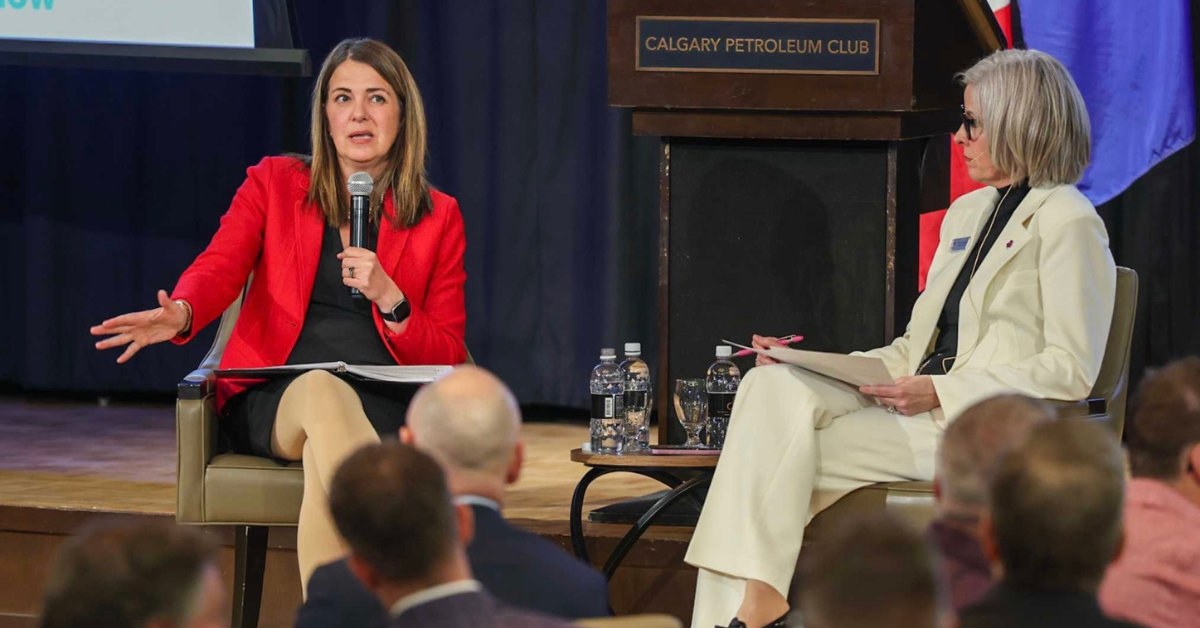
At a pivotal moment in the dialogue about Canada’s role as an energy superpower, Canada Powered by Women’s CEO, Tracey Bodnarchuk, sat down with Alberta Premier Danielle Smith on January 20 for a fireside chat at the sold-out Energy Now Insights Event attended by over 300 business leaders.
Canada’s energy and economic choices are making global headlines and shaping how the country competes, grows, and secures long-term prosperity.
Premier Smith shared her perspective on Alberta’s role within Canada’s broader economic and energy ambitions, how Canada is perceived by investors and trading partners, and what is needed to align policy with the realities of global markets. Here are five key themes Premier Smith addressed during our conversation.
What it means to be an energy superpower
The term “energy superpower” is used frequently in public and political discourse. Traditionally, it’s referred to the ability to produce, export, and reliably supply energy at scale. We asked Premier Smith how she defines the term and whether Canada meets that standard today.
Premier Smith:
Canada’s strength lies in its diversity, with each province contributing something different. Nova Scotia’s offshore wind ambitions, Ontario’s leadership in nuclear power, Saskatchewan’s uranium resources, Alberta’s oil and natural gas production, British Columbia’s natural gas potential, and the critical minerals found across the country all underpin a resilient national energy system. That system is increasingly important beyond traditional energy use. Countries that can deliver stable, affordable power will be the ones that capture investment in forward looking AI data centers, for example. For Canada, this reinforces the importance of building and maintaining energy infrastructure now, because future growth will depend on it.
Taken together, this diversity will allow Canada to position itself as an energy superpower built on reliability and long-term economic resilience.
Perception of Canada and Alberta at home and abroad
Premier Smith has engaged extensively with international leaders and investors, as well as provincial counterparts and business leaders across Canada.
We inquired how Canada is currently viewed by investors, whether that perception is changing, and how Alberta approaches global engagement when national messaging has often downplayed energy sources like oil and natural gas.
Premier Smith:
Alberta has stepped into a more active international role out of necessity, rather than leaving energy advocacy to federal or other provincial leadership or industry alone. The scale of Canada’s oil and natural gas resources and the country’s importance as a reliable supplier to allies hasn’t always been well understood. Canada surpassed Saudi Arabia as the largest supplier of oil to the U.S. in 2012, but this isn’t widely recognized. By engaging directly at major global forums and with key trading partners, Alberta has worked to strengthen relationships and restore confidence among investors.
Connecting energy development more directly to economic stability and household well-being is essential to rebuilding trust and momentum.
Policy certainty and the limits of memorandums
Late last year, Alberta and the federal government signed a memorandum of understanding aimed at resetting discussions on infrastructure and market access. While framed as progress, it has also been described as necessary but not sufficient.
Premier Smith told us how she views that characterization and what policy changes are needed regardless of any single project.
Premier Smith:
The MOU has created space for progress, even if it has not helped resolve deeper policy challenges. The MOU reopened practical options such as pipelines, optimizing current infrastructure, and advancing new opportunities to commit to future transportation capacity that had not been viable before. This is restoring flexibility across the system rather than committing to any single project. At the same time, the MOU is a test of intent, and its value will ultimately be judged by whether governments deliver timely decisions that give proponents confidence. Without that follow-through, memorandums risk remaining symbolic rather than enabling real investment.
Pipelines, markets, and economic realism
Market access remains central to Alberta’s economic outlook and to Canada’s ability to capture full value for its resources. We asked whether, under current policy conditions and projected oil prices, new export infrastructure is economically viable. We also explored alternative routes and how Alberta is weighing those options alongside the political and regulatory realities in British Columbia.
Premier Smith:
Market access is essential to Alberta’s economic outlook and to Canada’s ability to capture full value for its resources. Relying on a single customer or route is no longer viable, particularly given uncertainty in the Canada U.S. relationship. While prices and policy conditions matter, Alberta producers remain competitive, but the greater risk lies in failing to build the infrastructure needed to reach new markets.
There are multiple pathways under consideration, including west coast access through northern British Columbia, expansions of existing pipelines, oil by rail, and potential routes east and southeast. No single project should be treated as the only solution, restoring optionality is key.
On consultation, engagement is necessary, but consensus cannot become a veto. Working directly with rights-holding Indigenous nations, and with Indigenous equity participation as an option, is a practical way to align economic opportunity with responsible development. Where opposition remains, governments must still weigh the national interest, including affordability, energy security, and economic stability, and be prepared to make decisions.
Partnerships and the path forward
Indigenous partnerships are now foundational to any major infrastructure project in Canada. Premier Smith told us how Indigenous involvement can be structured to support shared economic outcomes. Finally, we were curious about what gives Premier Smith optimism.
Premier Smith:
Indigenous partnerships are now central to moving projects forward, with equity ownership creating more durable and constructive relationships. By supporting Indigenous participation through mechanisms like loan guarantees, projects can deliver long-term economic benefits while strengthening local decision-making.
I’m cautiously optimistic that momentum is shifting. More Premiers are recognizing the costs of delay and the need to build infrastructure that supports affordability, energy security, and public services. As public attitudes evolve and Canadians link energy development more directly to economic stability, there is an opportunity to move from debate to action, provided governments are willing to make decisions and Canadians stay engaged in shaping the country’s economic future.
In conclusion
Taken together, Premier Smith’s remarks point to a shift driven less by ideology and more by economic reality. Mounting affordability pressures, fiscal constraints, and global uncertainty are forcing a more pragmatic conversation about energy and growth.
That perspective aligns closely with CPW’s research and the priorities of engaged women, which show rising support across the country for responsible energy development as costs, reliability, and economic stability become more immediate concerns. In that context, energy security has emerged not as a regional issue, but a national one, tied to Canada’s ability to sustain public services, strengthen investment confidence, and compete in an increasingly volatile global environment.
In these increasingly uncertain times, there is opportunity – Canada can seize this moment and learn to build more effectively, unlocking its full potential as a responsible and competitive energy and resource leader both at home and globally.
Our sincere thanks to Premier Danielle Smith, and EnergyNow co-founder Terry J. Winnitoy and team for their leadership, generosity, and commitment to bringing together an important and timely conversation.