

New national research from Canada Powered by Women (CPW) shows that support for energy development among engaged women has reached its highest point in four years of tracking. Engaged women aren’t just looking for intentions but demanding the decisive action and energy independence required to secure Canadian prosperity, even as confidence in the government’s ability to deliver on development remains low.
We’ve been presenting the findings over the last few weeks as part of our Powering Prosperity national tour, and this week we’re sharing what we’ve been hearing along the way.
Overall, the numbers are landing the same way in every room: women want results, not announcements.
Here is a snapshot of some of the data:
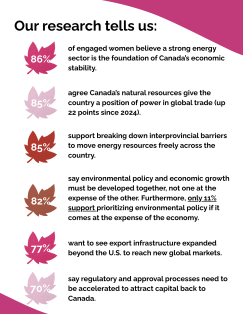
The full summary of the research is available on the CPW website, and as part of the Powering Prosperity national tour with presenting partner ATCO, we’ve stopped in five different Canadian cities in the last month to share this new data, host conversations, and hear insights.
Each stop has reflected its own regional priorities, shaped by local industries, infrastructure, and economic pressures. But across all of them, a consistent theme has emerged: women connect energy policy directly to cost of living, job stability, and Canada’s ability to build independence and compete economically.
Here is what each region brought forward in our conversations:
| Regina
Saskatchewan’s export-driven economy made the relationship between energy, agriculture, and infrastructure a central theme. When pipeline capacity is constrained, oil moves by rail, and that displaces the rail cars that grain farmers depend on to reach export markets in more than 130 countries. The industrial carbon tax, which applies to both mining and fertilizer production, adds cost pressure to a sector already navigating volatile international pricing. Women in Regina are seeing these cross-sector connections clearly. |
| Halifax
Nova Scotia has built its energy identity around electricity and renewables, but a new provincial energy and economic strategy is expanding that picture significantly. Plans now include developing offshore oil and gas and reducing the province’s full dependence on imported petroleum, while continuing to invest in wind and positioning Atlantic Canada as a global energy gateway. The conversation in Halifax reflected optimism about the direction, the need to continue making progress on environmental and economic goals, alongside a clear expectation that implementation must follow. |
| Calgary
With the federal-Alberta agreement as the backdrop, Calgary’s conversation focused on reasonable timelines and predictable conditions for capital. The focus was on removing barriers to investment, approving a west-coast pipeline, and demonstrating that policy commitments translate into projects. Women in Calgary were specific: optimism about the current moment needs to be backed by decisions that show up on with shovels in the ground. |
| Toronto
Leaders and industry experts from a diversity of business sectors gathered to connect regional perspectives to national priorities. We were also joined by Ontario Minister of Energy and Mines the Honourable Stephen Lecce, who called for greater unity in advancing Canada’s energy future. The discussion highlighted nuclear, natural gas, and hydro, and how they each contribute to Ontario’s energy needs, as a clear example of why we need a diverse energy mix. Critical minerals, the Ring of Fire, and nuclear expansion at Darlington and natural gas were also part of the conversation. |
| British Columbia
Lots of discussion about how many existing policies were made for a different time and context that’s not the same as today. British Columbia generates roughly 90 per cent of its electricity from hydroelectric power. A multi-year drought has cut output and for three consecutive years the province has had to buy more electricity than it produces. Demand is also rising, driven by population growth, electrification, and industrial expansion. The province brought a new hydroelectric dam online in 2025 to add capacity, but B.C. still isn’t generating enough to meet its needs. What’s clear for BC is the infrastructure decisions ahead will matter along with diversifying the energy mix. |
We do this research to amplify the voices and perspectives of engaged women, but we also learn a lot when we tour the country to talk about the findings and deepen the context around what women care about.
Our CEO Tracey Bodnarchuk says “At every event there’s a moment where people realize they’re more aligned than they thought. If we were only having conversations in certain parts of the country and not sharing what we’re learning coast-to-coast, we wouldn’t see how connected these perspectives really are. Canada’s energy resources are something women are proud of. This can be a unifying force that helps move the country forward when it comes to prosperity, jobs, and stronger social systems – all the things women are looking for in their lives and for their families.”
Thank you to everyone who joined us at each stop. Check out a selection of photos from some of our stops, and watch CPW socials for more in the coming weeks: